Resource guide · South Africa
Is Forex Trading Legal in South Africa? How Brokers Are Regulated
Yes, through a broker the FSCA authorises. How the Twin Peaks regulators work, how to check a broker's FSCA licence before you deposit, where a complaint goes, and the exchange control rules on funding a broker abroad.
In this hub, you'll find
- Forex trading is legal in South Africa through a broker the FSCA authorises as a financial services provider.
- Twin Peaks: the FSCA regulates conduct and licenses brokers; the Prudential Authority, inside the Reserve Bank, supervises banks and insurers.
- Check the company that will hold your account on the FSCA register, not the global brand.
- Complaints go to the broker first, then to the FAIS Ombud, which is free to use.
- Money sent to a broker abroad counts against your Reserve Bank exchange control allowances.
Is forex trading legal in South Africa?
Yes. South African residents can trade forex and CFDs through a broker authorised by the Financial Sector Conduct Authority (FSCA).
It is also not illegal to open an account with a company abroad, but South African protections may not follow you: a company that holds no FSCA authorisation is likely to sit outside the FSCA's conduct rules, and a complaint about it may be outside the reach of the FAIS Ombud. Its home regulator's rules apply instead. Money you send to any broker abroad is a foreign exchange transaction and counts against your exchange control allowances.
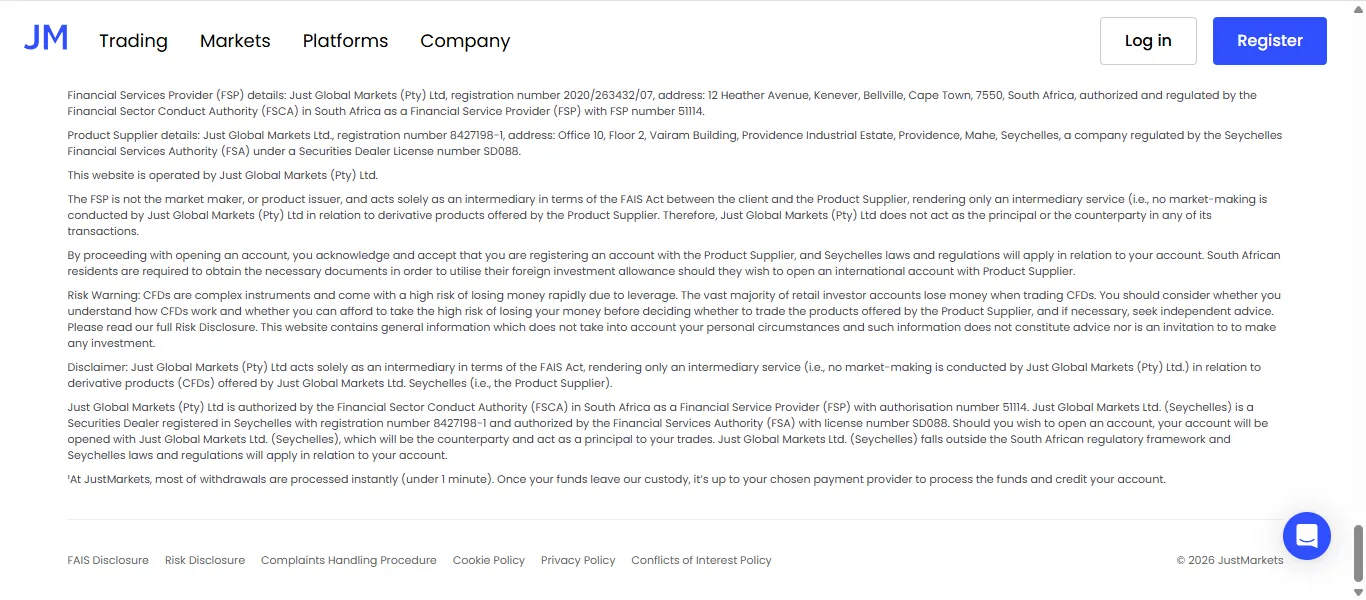
The rule that runs through this page: check the company that will actually hold your account, not the global brand. That company decides your regulator and your protections. Once you know what to look for, our comparison of FSCA-regulated forex brokers is the place to start.
Twin Peaks: the FSCA and the Prudential Authority
Since April 2018, South Africa has regulated its financial sector under the "Twin Peaks" model set up by the Financial Sector Regulation Act of 2017. One peak regulates how financial firms treat their customers; the other, whether those firms are financially sound.
The FSCA is the conduct peak, and the one a forex trader deals with day to day: it authorises brokers as financial services providers and keeps the register you check them on.
The Prudential Authority is the prudential peak. It sits within the South African Reserve Bank and supervises the capital, liquidity and risk management of banks, insurers, co-operative financial institutions, financial conglomerates and market infrastructures. It does not license forex brokers.
It still touches your money. A broker is required to keep client funds separate from its own, at a bank, and a South African bank is supervised by the Prudential Authority. Since 1 April 2024, bank deposits are also covered by the Corporation for Deposit Insurance (CODI), which insures qualifying depositors up to R100,000 per depositor, per bank, principal and interest included, if the bank itself fails. Two limits matter for a trader: that cover protects you against the bank failing, not against the broker failing or against trading losses, and how it applies to money a broker pools in a single client account is not straightforward. The real protection for your funds is segregation, covered below, not deposit insurance.
| Regulator | Full name | What it covers | Public register |
|---|---|---|---|
| FSCA | Financial Sector Conduct Authority | Market-conduct regulator. Licenses financial services providers, including forex and CFD brokers, and keeps the public register of them. | Search the FSCA register |
| Prudential Authority | Prudential Authority within the South African Reserve Bank | Supervises banks, insurers and market infrastructure, rather than licensing brokers. | No broker register. Supervised banks and insurers are listed on the Reserve Bank's Prudential Authority pages. |
What the FSCA does, and what a licence covers
The FSCA is South Africa's market-conduct regulator: it licenses and supervises financial institutions on how they treat their customers. It was established on 1 April 2018 under the Financial Sector Regulation Act, taking over from the Financial Services Board.
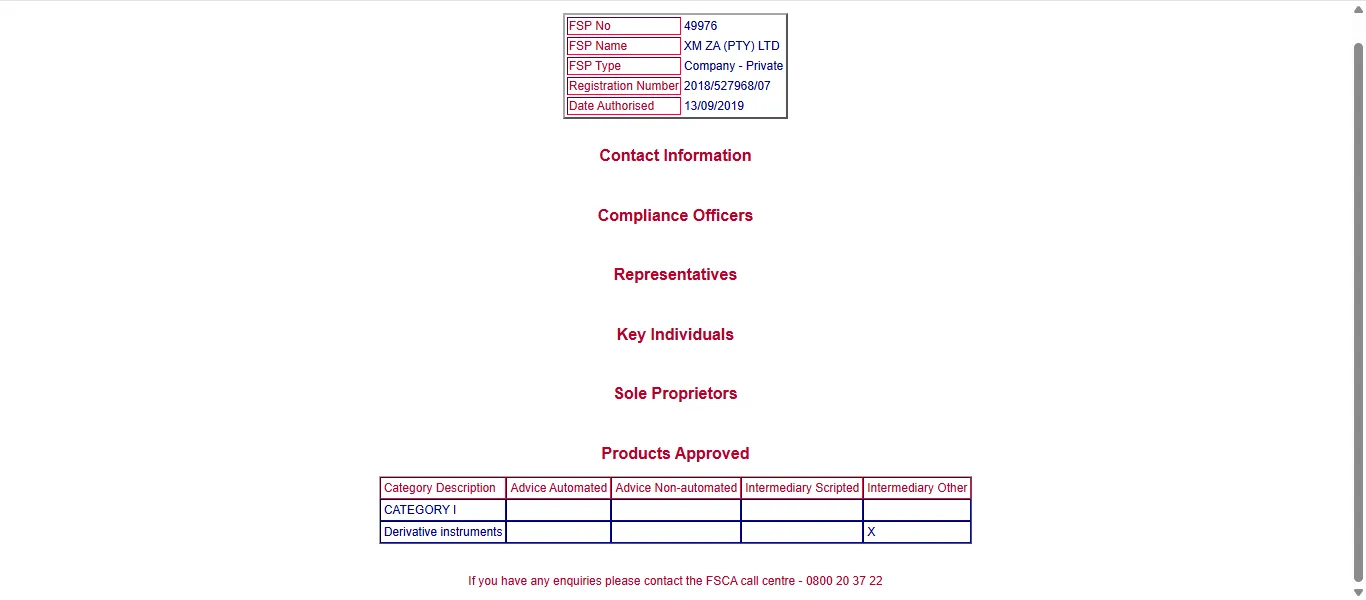
A broker that is genuinely FSCA-regulated is authorised as a financial services provider (FSP) under the Financial Advisory and Intermediary Services (FAIS) Act of 2002, carries an FSP number, and appears on the FSCA's public register. The licence lists the categories of service and the products the provider is authorised for, and that list matters more than the fact that a licence exists.
There are two separate authorisations to look for, and they are not the same thing:
- A FAIS licence authorises a firm to give advice and render intermediary services, which covers marketing, selling and advising on CFDs.
- An over-the-counter derivative provider (ODP) authorisation is the other. Under the Financial Markets Act's ODP Regulations, a firm that issues CFDs as principal as a regular feature of its business needs ODP authorisation.
Where the company that issues your CFDs is abroad, check which regulator authorises it; the FSCA's ODP register lists the firms it has approved. When you check a broker, confirm which of these authorisations each of its companies holds.
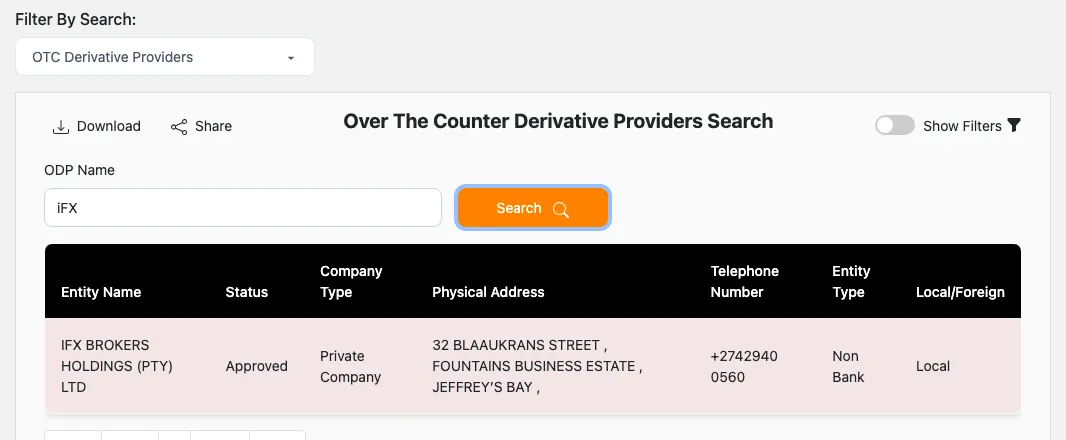
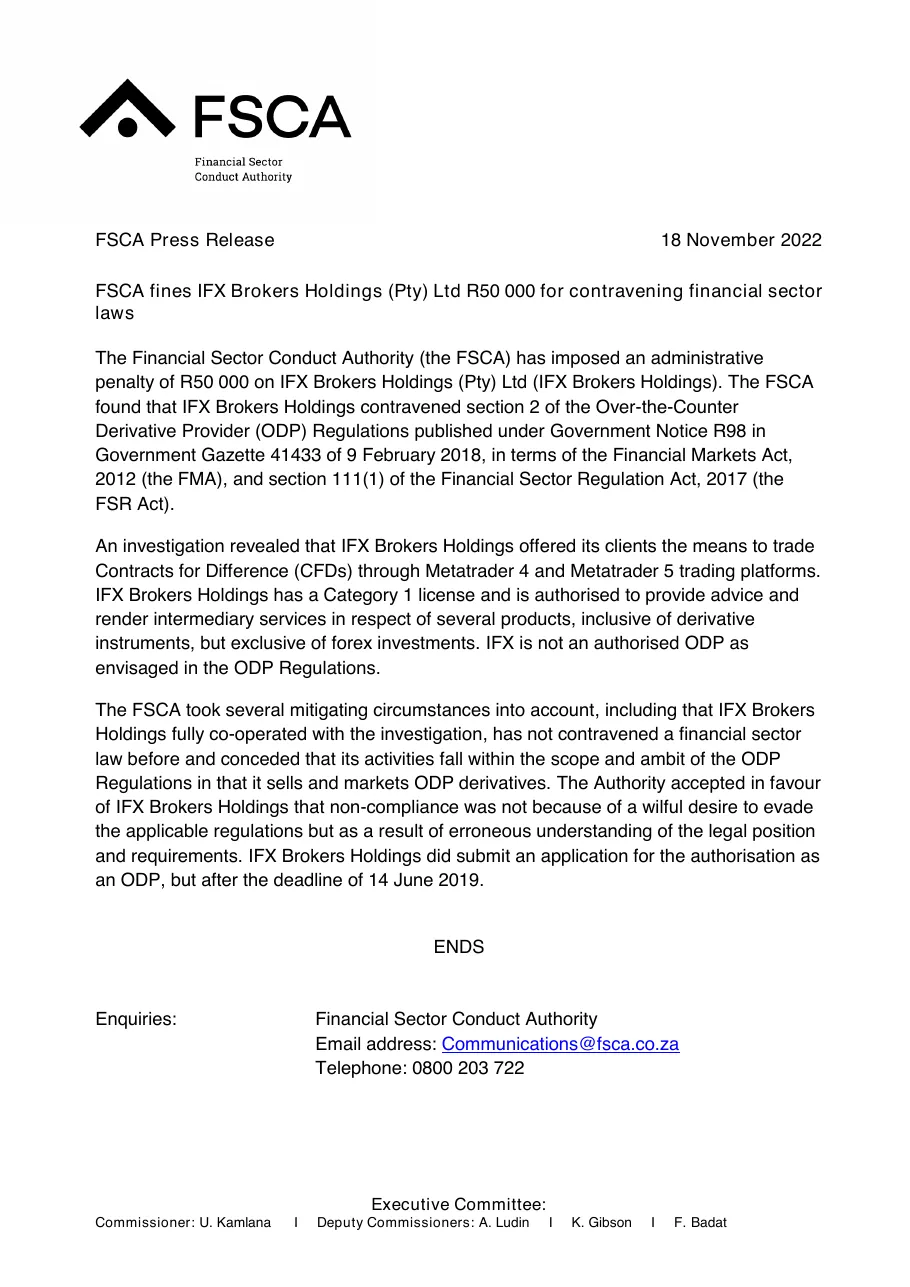
A licence to act as an intermediary is not a licence to hold your money or take the other side of your trades, so check what the licence actually permits.
Being FSCA-authorised is still a meaningful signal. In practice, an authorised provider is subject to:
- Fit-and-proper requirements for the firm and the people who run it.
- Conduct rules on disclosure, fair treatment and complaint handling.
- Client-money rules: an authorised provider must keep client funds separate from its own money, in a designated account, so that your money is identifiable and does not form part of the firm's own assets.
- Supervision and enforcement, including public warnings about unauthorised firms, which we collect on our FSCA warnings list.
One limit is worth stating plainly: South Africa has no statutory investor compensation scheme that pays out clients of an FSCA-authorised forex or CFD broker if the broker fails. Segregation keeps your money apart from the firm's own, so it should be returnable if the firm is solvent. It is not the same as being compensated if the firm fails.
How to check an FSCA licence
- Find the exact company name in the broker's footer or legal pages, including any suffix.
- Search that name, or the FSP number, on the FSCA's register.
- Confirm that the status is active and that the authorised products cover what you are being sold.
- Check whether this company is the one that will hold your account. If the account sits with a sister company in another country, find out which regulator authorises that company too.
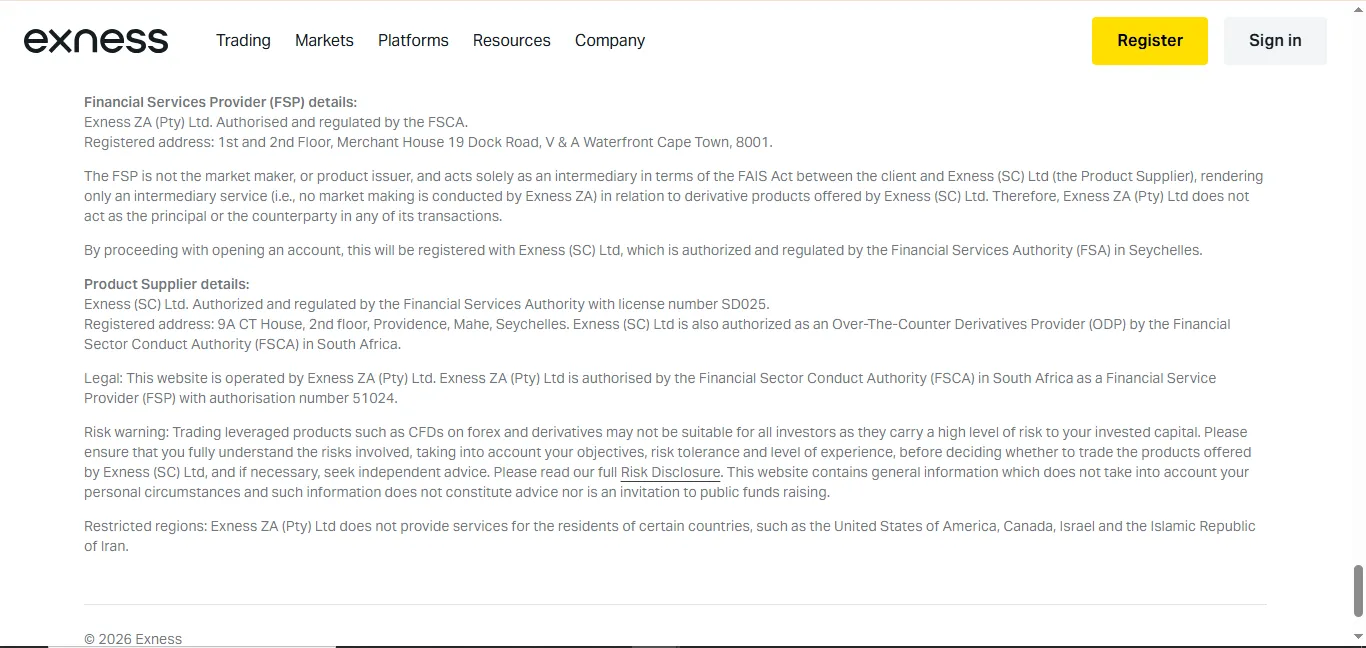
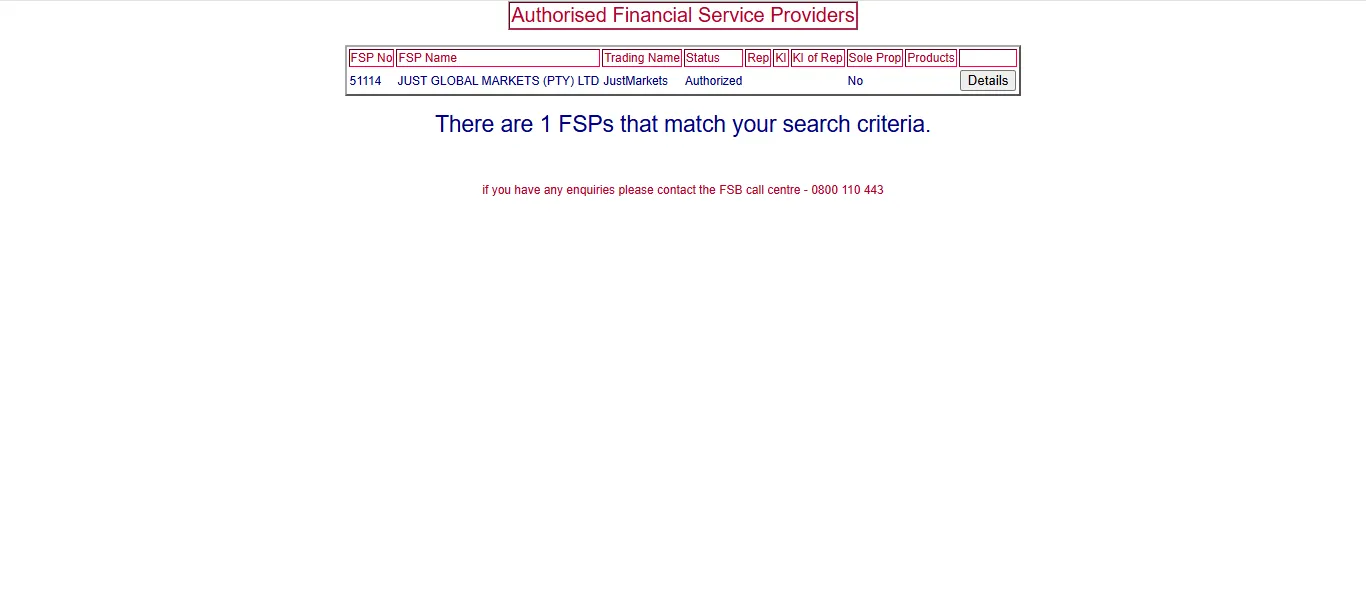
If a firm claims FSCA authorisation but is not on the register, appears with narrower permissions than it advertises, or names a different company from the one in your agreement, stop and get a written explanation before you fund an account.
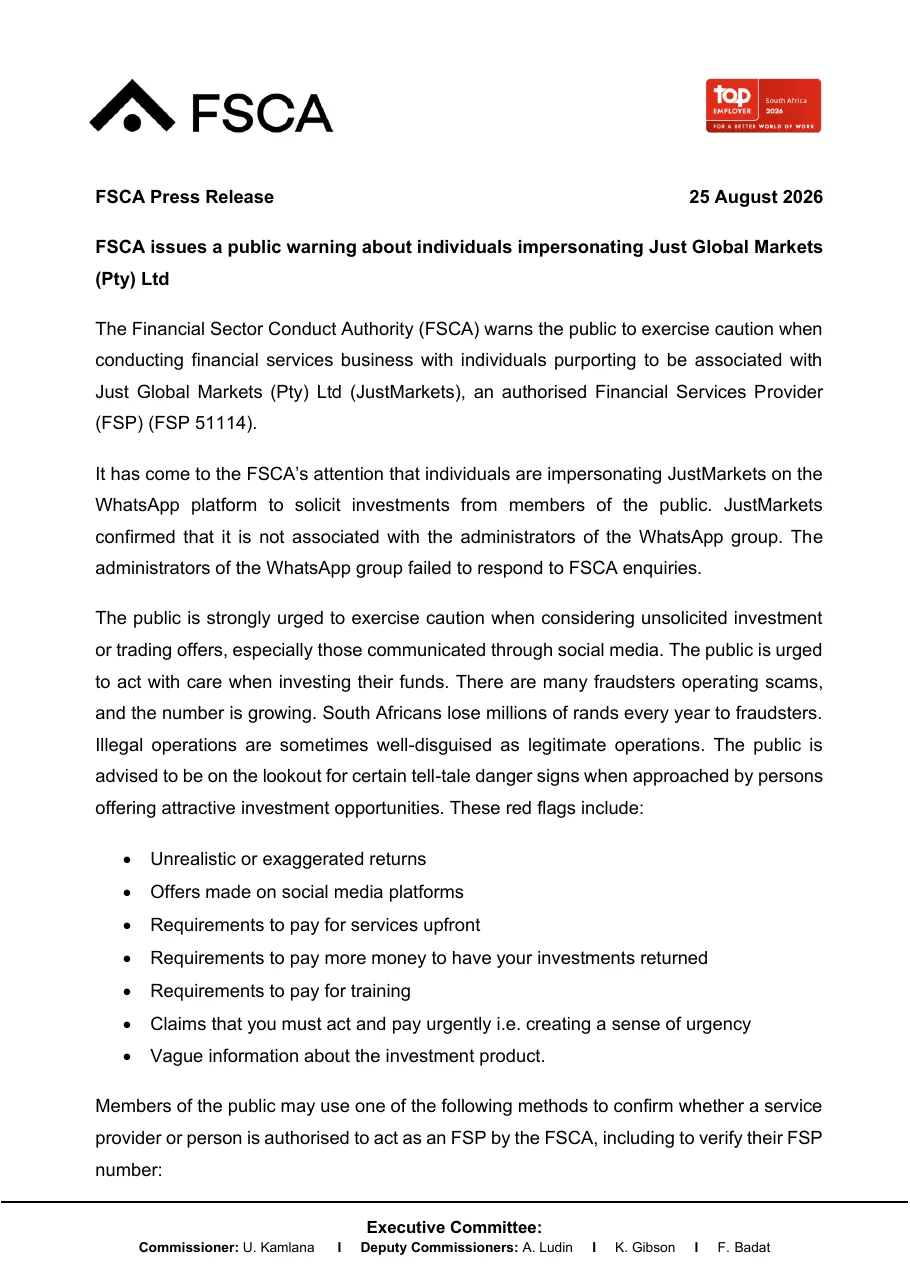
Scammers also clone genuine firms and quote real FSP numbers. Reach the broker through the contact details on the register, not the ones a caller or website gives you, and check it against our FSCA warnings list.
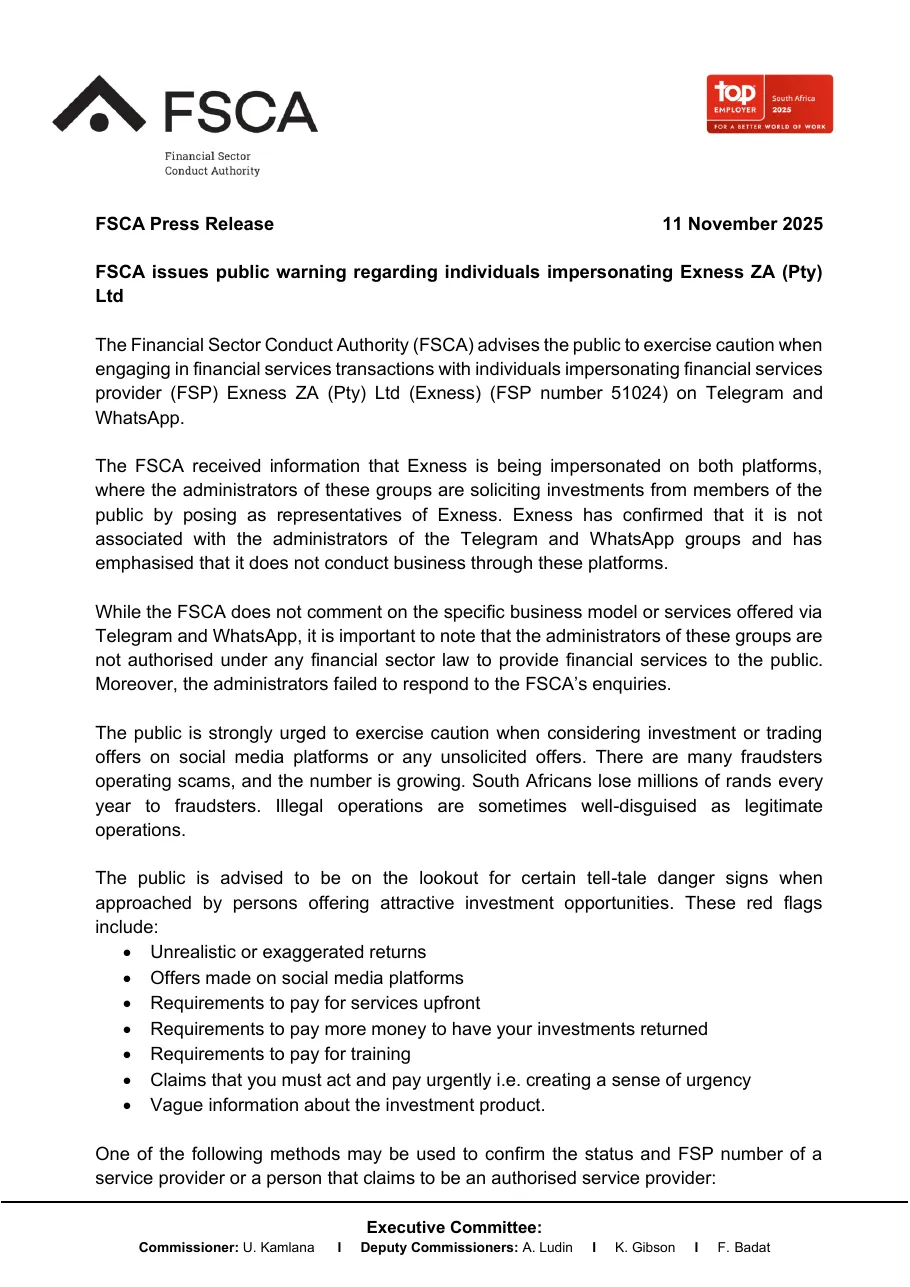
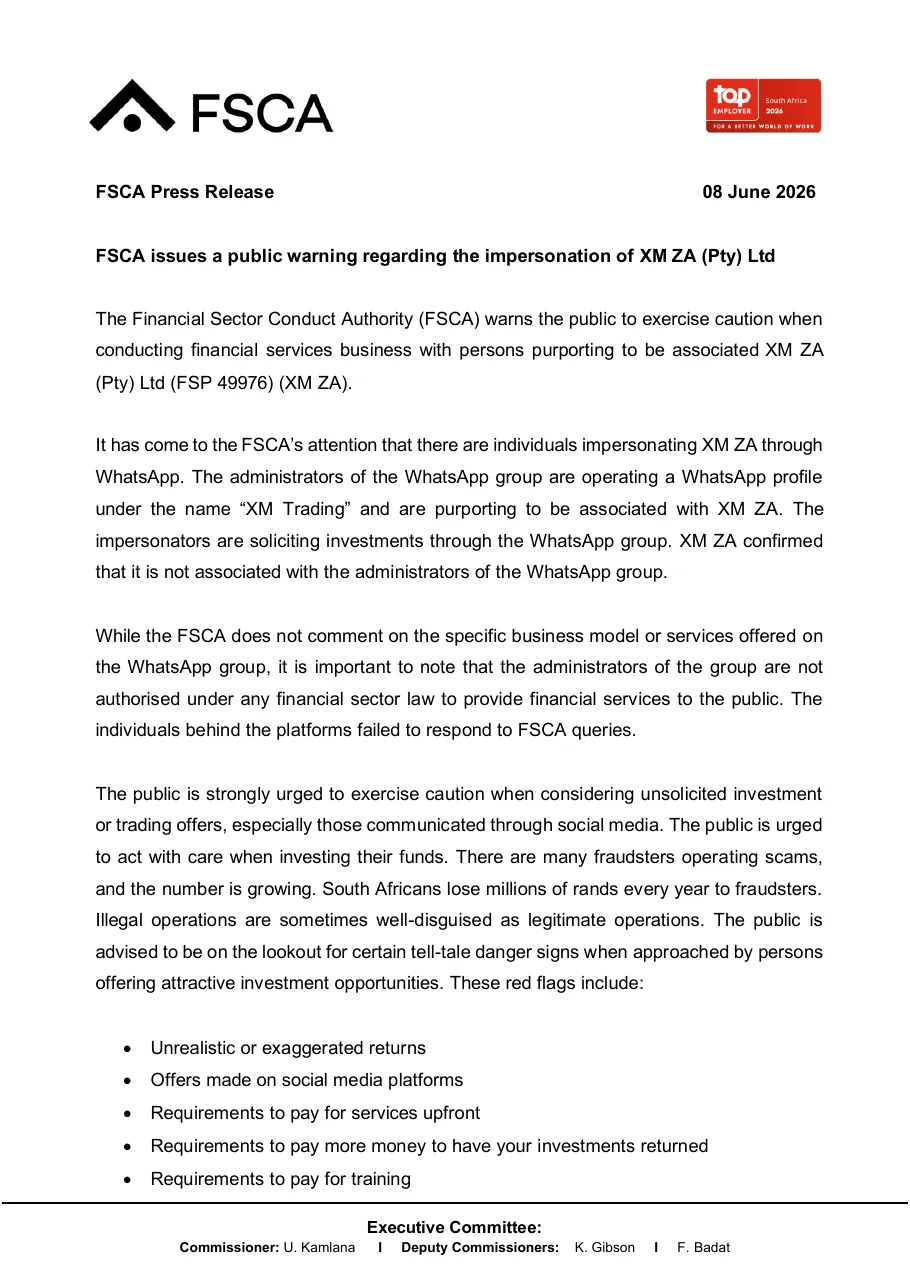
FSCA registerOur FSCA warnings list →How we verify a broker's regulation →
The FSCA licences of the brokers we review
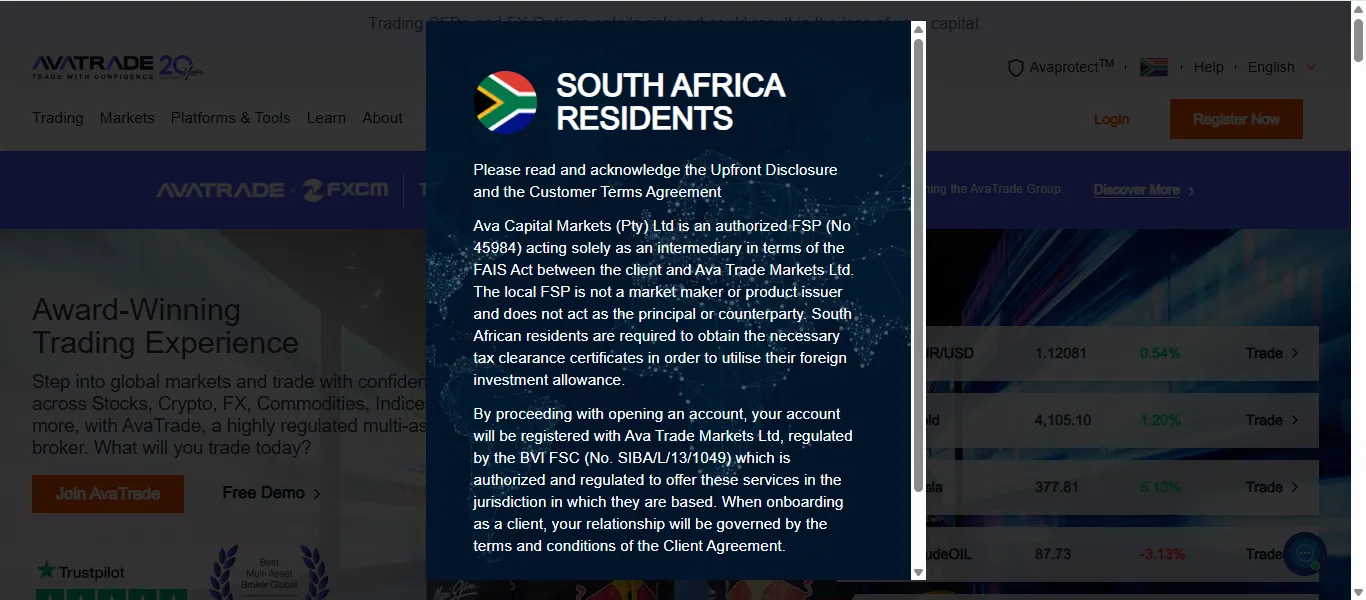
Each broker we review holds an FSCA licence through at least one company. The FSCA-licensed company is not always the one a South African client's account is opened with: some groups open local clients' accounts with a company abroad. The table names that company for each broker, as its review does.
| Broker | FSCA licence (FSP number) | FSCA-licensed company | Account held with | Last checked |
|---|---|---|---|---|
| Exness | 51024 | Exness ZA (Pty) Ltd | Exness (SC) Ltd, Seychelles (FSCA and FSA) | 04 Nov 2026 (register) |
| XM | 49976 | XM ZA (Pty) Ltd | XM Global Limited, Belize (FSC) | 09 Nov 2026 (register) |
| AvaTrade | 45984 | Ava Capital Markets (Pty) Ltd | Ava Trade Markets Ltd, British Virgin Islands (BVI FSC) | 09 Nov 2026 (register) |
| JustMarkets | 51114 | Just Global Markets (Pty) Ltd | Just Global Markets Ltd, Seychelles (FSA) | 12 Nov 2026 (register) |
| iFX Brokers | 48021 | iFX Brokers Holdings (Pty) Ltd | iFX Brokers Holdings (Pty) Ltd, South Africa (FSCA) | 17 Nov 2026 (register) |
Where to complain: the FAIS Ombud
Complain to the broker first, in writing. If that does not resolve it, the Office of the Ombud for Financial Services Providers, known as the FAIS Ombud, can take it. Set up under the FAIS Act, it resolves complaints against authorised financial services providers, forex brokers included, informally and at no charge to the person complaining.
What it can do: the Ombud can make a determination that is binding and enforceable in the same way as a judgment of a court. It can consider a monetary claim of up to R3,500,000, unless the broker agrees in writing to a higher amount.
The Ombud expects the broker to have had the chance to put things right first:
- Put the complaint to the broker in writing, and keep a copy.
- Give the broker six weeks to respond.
- If you are not satisfied with the final response, you have six months from receiving it to take the complaint to the Ombud.
- Keep everything: statements, chats, emails, screenshots and the client agreement.
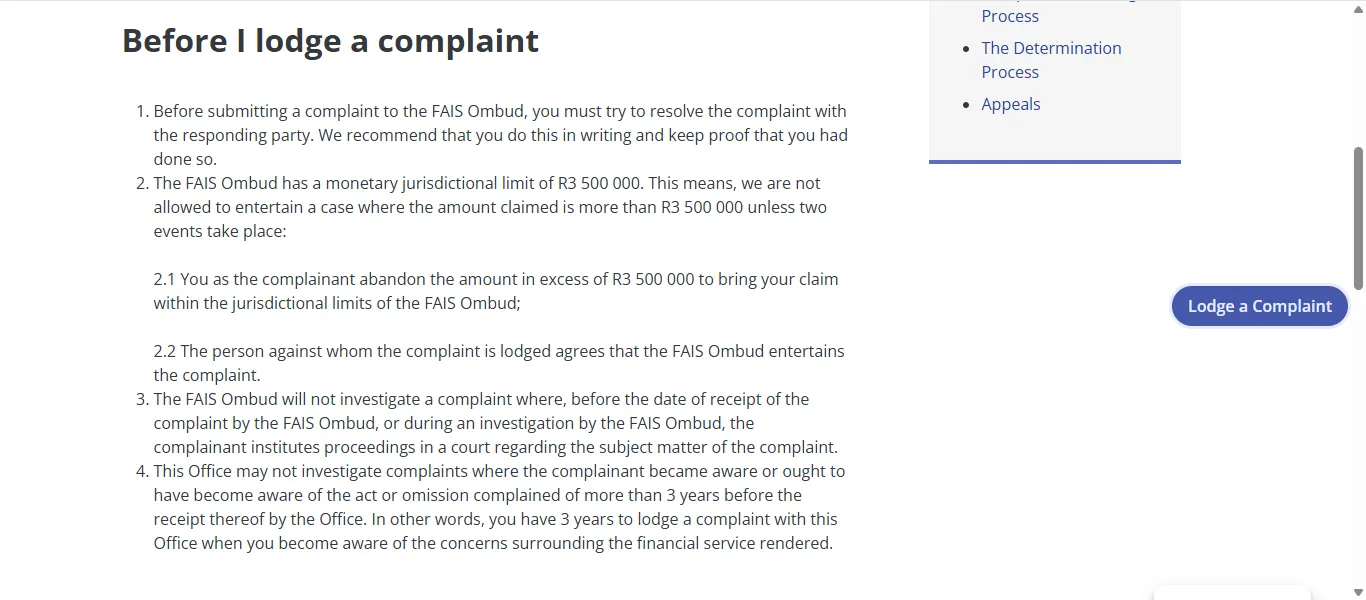
The act or omission you are complaining about must have happened on or after 30 September 2004.
It can only consider a complaint against a provider authorised under the FAIS Act. If your account is with a company abroad that holds no FSCA authorisation, a complaint about it may be outside the Ombud's reach: one more reason to check which company holds your account before you deposit. A loss that comes purely from the market moving against you, rather than from any conduct failing by the broker, is also not something the Ombud is there to reverse.
To lodge a complaint, use the complaint process on the FAIS Ombud's website, set out what happened and what you want, and attach your client agreement, account statements and all correspondence with the broker. The Ombud will acknowledge it, may refer it back to the broker to resolve, and will investigate if it is not settled.
The Reserve Bank and exchange control
The South African Reserve Bank (SARB) is the central bank. It sets monetary policy, issues the rand and houses the Prudential Authority, but it does not license forex brokers. For a trader, its most relevant job is exchange control: the rules on moving money out of South Africa, administered by its Financial Surveillance Department through the banks that act as authorised dealers in foreign exchange.
A broker that accepts ZAR into a South African account can spare you a foreign transfer and a currency conversion. Our forex broker comparison shows which accounts can be held in ZAR, and each review confirms how that broker handles ZAR deposits.
When you send ZAR to a broker's account abroad, the transfer is a foreign exchange transaction. Your bank, acting as an authorised dealer, reports it and runs it against your allowances. The allowances that apply to an individual resident:
| Allowance | Annual limit | What it requires |
|---|---|---|
| Single discretionary allowance | R2 million per calendar year (raised from R1 million by the Reserve Bank's Exchange Control Circular 6/2026, effective 8 April 2026) | No prior SARS approval or AIT PIN needed up to the limit. Available to residents 18 and older. |
| Foreign investment allowance | R10 million per calendar year | Runs through the Approval for International Transfer (AIT) and SARS tax clearance process. Amounts above R10 million need additional Reserve Bank approval. |
Why your broker asks for FICA documents
The Financial Intelligence Centre (FIC) is South Africa's financial intelligence unit, set up under the Financial Intelligence Centre Act of 2001 to combat money laundering and terrorist financing. It receives and analyses reports of suspicious and unusual transactions and passes intelligence to the authorities that investigate. It does not license brokers or handle complaints about them.
Financial services providers authorised under the FAIS Act are accountable institutions under the FIC Act, so they must establish and verify who their clients are before doing business with them. That check is what South Africans call "FICA". In practice a broker will ask for:
- Proof of identity: a South African green barcoded ID book or smart ID card, or a passport.
- Proof of residential address dated within the last three months, such as a utility bill, municipal account, bank statement or signed lease.
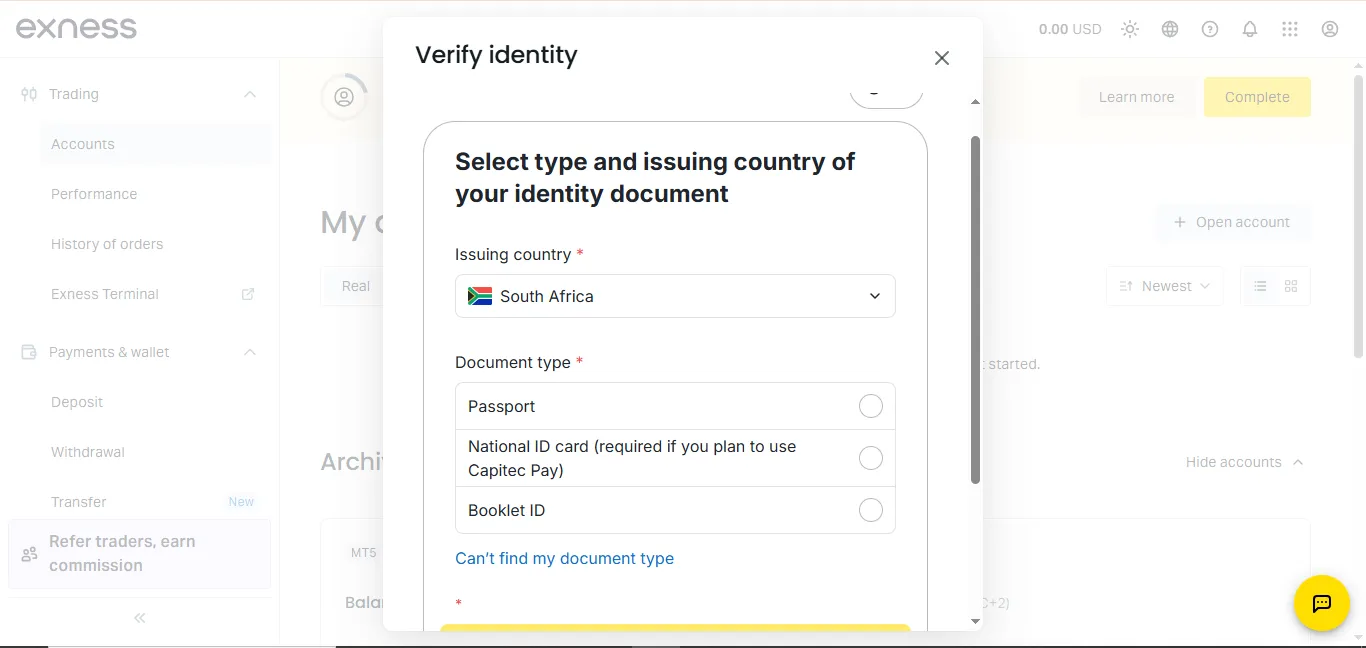
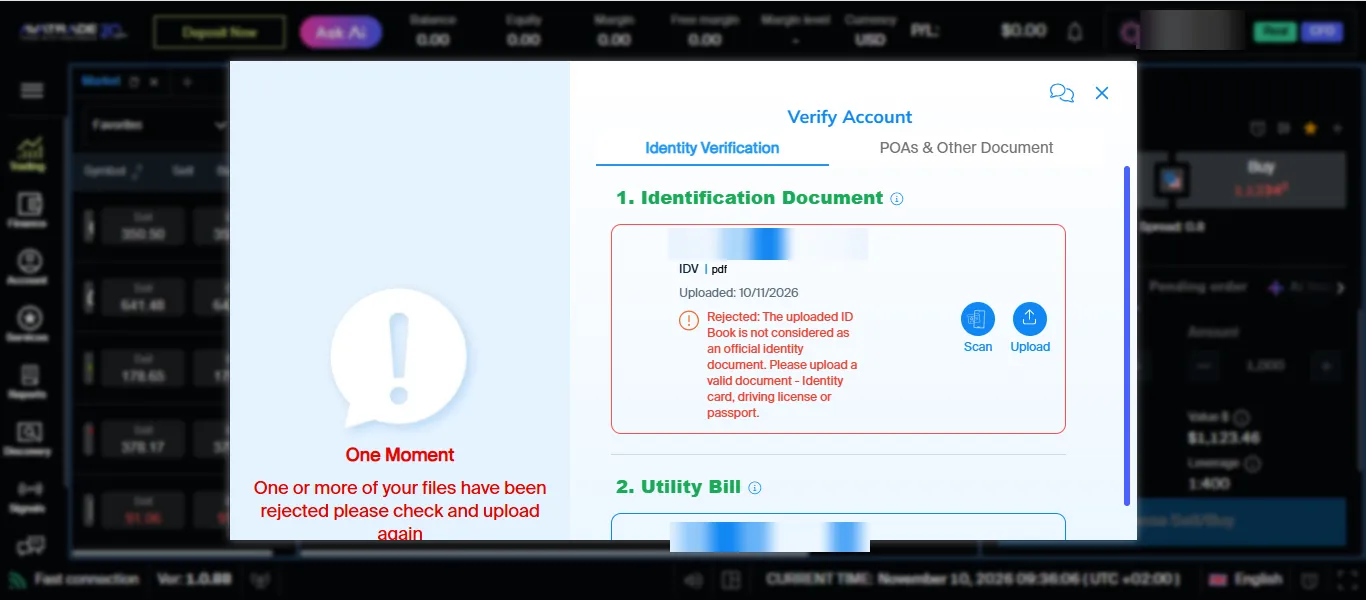
A firm that lets you deposit before it checks who you are, asks you to pay into an individual's bank account, or accepts payment only in crypto, vouchers or gift cards is one to check against our FSCA warnings list before you go further.
The NCR and the JSE
Neither licenses forex brokers.
The National Credit Regulator (NCR), set up under the National Credit Act of 2005, registers credit providers and enforces the Act's rules on lending. The Act governs credit agreements, which are loans. If you borrow money to fund a trading account, that loan is credit, the lender must be a registered credit provider, and the Act's protections apply to it. Borrowing to trade leveraged products compounds the risk of both. The leverage a broker gives you on a trading account is different: it is margin provided under your trading agreement, not a loan from a credit provider, so it generally falls outside the National Credit Act.
JSE Limited runs South Africa's main stock exchange and is licensed as an exchange under the Financial Markets Act. As well as shares, it lists derivatives, including currency futures on the rand, such as the dollar/rand future. Those futures and a broker's CFDs both give you exposure to the rand's exchange rate, in different ways:
| JSE currency futures | Forex CFDs from a broker | |
|---|---|---|
| Where it trades | On the exchange, through a member firm | Over the counter, with the broker as counterparty |
| Price | The exchange's order book | The broker's quote |
| Contract size | US$1,000 per standard contract, or US$100,000 for a Maxi dollar/rand contract | Flexible lot sizes |
| Who you check | The JSE member firm, on the FSCA register, and the exchange's own rules | The broker, on the FSCA register |
To trade JSE currency futures, you register as a client with an authorised JSE Commodity Derivatives member firm and put up the required initial margin.
Related broker rankings & reviews
South Africa-specific note
A broker serving clients in South Africa may be licensed by the FSCA, by an overseas regulator or both, through different companies. Always confirm which company holds your account, and check it on the register yourself.
Frequently asked questions
Is forex trading legal in South Africa?
Who regulates forex brokers in South Africa?
How do I check if a broker is FSCA-regulated?
What is an FSP number?
Is an FSCA-regulated broker safe?
Is my money protected if a broker fails?
Where do I complain about a broker?
Can the FAIS Ombud help with a broker abroad?
Do I need Reserve Bank approval to fund an offshore forex broker?
What are FICA documents?

Giles Thomas
Giles Thomas is Executive Director at FOE Global, a UAE-based family office and private equity advisory firm. He leads the broker research for ForexBroker SA and writes its reviews, checking each broker against the FSCA's public register, its client agreement and its own legal documents.